Overview
In June 2022, David Wechsler ran an informal multivariate electroculture trial comparing four different stimulation methods side-by-side on trays of microgreens seedlings, grown from seed indoors under artificial lighting in standard potting soil. Each pot of the tray setup received a different treatment (or no treatment, as a control), allowing rough head-to-head comparison of several electroculture approaches under identical environmental conditions.
Setup
- Crops: Microgreens (multiple brassica varieties, identifiable by purple/green cotyledons)
- Plant stage: Seed (treatments began at/near germination)
- Substrate: Standard indoor potting soil
- Lighting: Artificial indoor lighting
- Layout: Six cell plant pots, each with a different treatment, arranged on a shared growing tray
Treatments (Quadrants)
Top-Left: Pulsed Stimulation
A breadboard/microcontroller-based pulsed DC stimulation circuit (custom “Harvest Storm Alpha” PCB), delivering low-frequency pulses (protocol not fully recorded — likely around 15 Hz) to electrodes in the soil.
Top-Right: Pulsed Stimulation
Second pulsed-DC stimulation quadrant, using the same or similar breadboard microcontroller circuit and electrode setup as Top-Left.
Center-Left: Earth Battery
A simple earth battery (dissimilar-metal electrodes, e.g., copper pipe + zinc galvanized steel wire, inserted into the soil) providing a small continuous galvanic current with no external power source.
Center-Right: Control
No electrical stimuli of any kind. Otherwise identical soil, watering, lighting, and seed source as the other quadrants.
Bottom-Left: Solar Cell
A small solar cell connected to electrodes in the soil, providing light-driven electrical stimulation proportional to ambient/artificial light exposure.
Bottom-Right: Tesla Coil High-Voltage Soil Stimulation
A steel rod with a pointed tip inserted into the soil received high-voltage stimulation from a Tesla coil at its lowest setting, held 1-2 inches away from the rod. Most energy transferred via direct discharge (arcing) to the point, with some additional distance-based charge transference noticeable by a change in the coil’s discharge sound when aimed at the rod. This HV stimulation was applied for approximately one minute during early growth stages.
Equipment
- “Harvest Storm Alpha” pulsed DC stimulation PCB (breadboard/prototype microcontroller circuit)
- “Harvest Storm Xtender” expansion I/O board
- Earth battery electrodes (dissimilar metals)
- Small solar cell with soil electrodes
- Portable Tesla coil (lowest power setting), with a pointed steel rod electrode
Results
Best performers (microgreens):
- Solar Cell and HV Tesla Coil Soil Stimulation — tied for best growth/vigor among the treated quadrants
- Pulsed DC (breadboard microcontroller) — second-best, noticeably ahead of the untreated control
The control center-right pot (no stimuli) lagged visibly behind all treated quadrants in overall growth and fullness.
Observations
- All microgreen quadrants germinated successfully and filled in densely, but density and leaf size were visibly greater in the solar cell and HV-stimulated quadrants.
- The earth battery quadrant showed growth intermediate between the control and the pulsed-DC quadrants, though this was not rigorously ranked.
- The Tesla coil discharge produced an audible change in tone/pitch when the arc was directed at the steel rod versus when it discharged elsewhere, used informally as a cue that energy was being delivered to the target electrode.
Photo
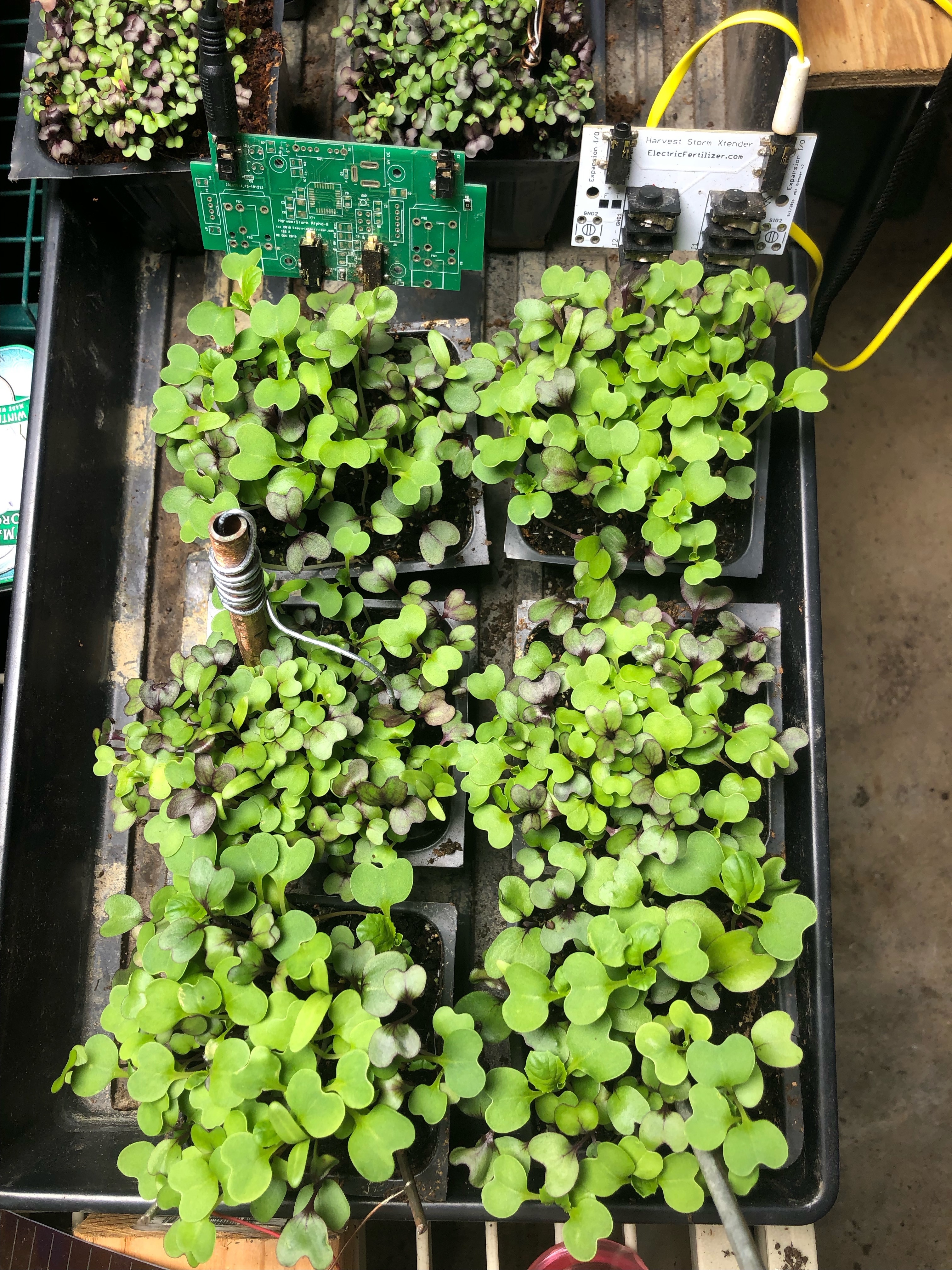 Six-cell tray showing the different stimulation treatments, including the Harvest Storm Alpha pulsed-DC PCB (top-left), Harvest Storm Xtender expansion board (top-right area), earth battery probe (center), and the steel rod electrode for Tesla coil HV stimulation (bottom-right).
Limitations
- Informal home trial — no replication, randomization, or statistical analysis
- Single tray/timepoint photo documentation; no quantitative height/weight/yield measurements recorded
- Pulsed DC protocol parameters (frequency, voltage, duty cycle) were not fully logged at the time
- Results are qualitative/visual rankings only, based on observed density and leaf development
Conclusions
This rough comparison suggests that solar-cell-driven electrical stimulation and Tesla-coil high-voltage soil stimulation were the most promising candidates for improving microgreen growth in this setup, with pulsed DC stimulation from a low-cost microcontroller circuit also outperforming the untreated control. These results are directional only and warrant a more rigorous, replicated follow-up trial with quantitative measurements (germination rate, fresh weight, height) across larger sample sizes.
Date: June 2022 Experiment Status: Complete (informal) Replication Status: Recommended — quantify with controlled replicates and measurements